|
Question 1 (Shota Utiashvili, Georgia)
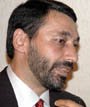
Hello Mr. Arzoumanian. Thank you very much for your consent to participate in our interview. My first question will be quite general. Could you describe in a few words the foreign policy of Armenia at present?
Answer: Hello. Thank you for the interest you have taken. I would rather have questions of a more specific character, if possible, for the topic you mentioned is boundless and it could be discussed for hours on end. Could you specify the aspects of Armenia’s foreign policy that are of interest for you?
Question 2 (Shota Utiashvili, Georgia)
You are heading the Turkish Armenian Reconciliation Commission. What is the state of affairs with the activities of that Commission, and do you think reconciliation is possible in the present circumstances?
Answer: As you know the Commission has been working since 2001. Since then we have met repeatedly, discussed the whole complex of problems existing between Armenia and Turkey, and we think we have reached some tangible concrete results. Three weeks ago we met in Istanbul and drafted the operative plan for the nearest future. In relation to the question of whether reconciliation is possible, in the present circumstances, I think reconciliation is a must, and it is quite unnatural that two neighboring countries do not have diplomatic, economic or trade relations with each other. Sooner or later Armenia and Turkey will establish normal relations, and the mission of our commission is to make a humble contribution to that. In regard to specific results the commission has acheived, I would mention first of all a publication by the International Center for Transitional Justice, the report - “The Applicability of the 1948 United Nations Convention on Genocide to the Events That Took place in Ottoman Turkey in the Beginning of the 20th Century.” In this document based on the research of a large number of documents both from Armenian and Turkish sources, the Center arrived at the conclusion that these events, in view of the UN Convention, constituted unequivocally genocide.
Question 3 (Shota Utiashvili, Georgia)
Do you think that the Turkish side would agree to that position? If the parties do not arrive at a common denominator on the issue of Genocide and the resolution of the Karabagh problem, then will the establishment of diplomatic relations be possible?
Answer: I would like to mention that the members of the commission, on the Armenian side and the Turkish, do not represent the governments of their respective countries. We are representatives of civil society and through our work we are striving to explore the routes through which Armenian-Turkish relations could develop. Those routes may be accepted or rejected by the corresponding governments. Our goal is contributing to the development of contacts between the citizens of the two countries, representing various layers of society. I mentioned the Report for I think the ICTJ conclusions could serve a good basis for building inter-governmental relations. Whether corresponding governments are ready to accept it or not is a matter of time. Regarding diplomatic relations, I would like to repeat that I think that the lack of such relations between Armenia and Turkey is unnatural. I think it counterproductive that the establishment of diplomatic relations is being conditioned on a whole set of historic circumstances existing between Armenia and Turkey. Regarding the Karabagh problem - this issue is related to Armenian-Azerbaijani interests and can never be considered in the context of Armenia’s relations with a third country. And that’s why the Turkish Armenian Reconciliation Commission at the very first meeting decided not to consider issues related to Armenian-Azerbaijani relations in general, and the Nagorno Karabagh conflict, in particular.
Question 4 (Shota Utiashvili, Georgia)
Your position is clear. Let us turn to another theme. How would you assess Armenian Russian relations at present? As is known, Russia is considered Armenia’s main ally on security issues, at the same time it controls a large chunk of the Armenian economy. It would be interesting to know your opinion on what Armenia has lost and what it has gained from such a partnership?
Answer: Thank you for a very interesting question. The foundations of the Russian-Armenian strategic partnership were laid immediately after the declaration of independence in Armenia. However, the developments of the last five years cannot but arouse our concern, for Armenia has ceased to be an equal partner, gradually turning into a junior partner, if not a vassal. The fact that Russia is becoming Armenia’s main strategic partner on security is also quite unnerving, for it is my firm convictions that all three South Caucasian countries should be included into a common system of security. And herein lie guarantees for the development of our region. Charting of any dividing lines in the South Caucasus is not in the interests of any of the countries in the region. And in that light my position on the establishment of the Collective Security Treaty Organization (CSTO), of which neither Georgia nor Azerbaijan is a member, is quite dubious. In relation to control over our economy, exertion of the formula “assets against debt,” is just another expression of Russia’s imposing its economic influence, with total disregard for the interests of a sovereign country, Armenia. Unless relations between Armenia and Russia are not returned to the equilibrium of equal partnership and complete respect, one of the sides, meaning Armenia, will always be the loser.
Question 5 (Shota Utiashvili, Georgia)
Thank you for a very interesting answer. In that context how do you feel about Azerbaijan’s and Georgia’s efforts to enter NATO? Do you consider it to be a new division line or a means for genuine regional cooperation on security issues?
Answer: As sovereign countries, both Azerbaijan and Georgia are free to choose their own security systems. As I said, it is very important that all the three countries of the region are incorporated in the same security system. The progression of events in our region, and on a larger scale -- around it, stir up reticent hopes that in the future all three countries of the region will find ways of mutually effective cooperation on security. Therefore, I do not consider Azerbaijani and Georgian endeavors to be integrated in NATO as a step to draw new division lines in the region.
Question 6 (Shota Utiashvili, Georgia)
Clearly, the creation of a regional security system would require the resolution of the Karabagh problem in a way acceptable to both parties. Do you expect the regulation process to pick up again after elections in Azerbaijan? To what extent do you think the sides are ready for the necessary concessions?
Answer: You are absolutely right. In order to establish a regional security system all of the conflicts - in Nagorno Karabagh, Abkhazia, South Osetia- must be resolved first … Only after the settlement of those problems will it be possible to speak about the dynamic development of the South Caucasus as a common economic zone. Naturally the recent presidential elections in Armenia and the upcoming presidential elections in Azerbaijan have slowed down the process of the peaceful regulation of the Nagorno Karabagh conflict. Right after the elections the negotiations will restart. Regarding the question of whether the sides are ready for compromise, it seems to me they are condemned to concede to a mutually acceptable resolution.
Question 7 (Shota Utiashvili, Georgia)
Armenia is interested in opening the railway route through Abkhazia, and is taking specific steps in that direction. The Georgian position is also clear - the road will be opened only after the return of refugees. As is known, the Armenian Diaspora in South Russia and Abkhazia is quite influential. Does it follow from this that the RA and the Diaspora will be actively contributing to the resolution of the Abkhazian conflict?
Answer: First of all, I would like to state once again that I do not represent the Government of Armenia and I cannot speak in its name. What I personally think is that both the Armenian leadership and the Armenian Diaspora in Russia should do their best in their efforts to resolve the Abkhazian issue. Armenia is naturally interested that the Abkhazian railway be opened, but the conflict can and must be resolved in the interests of the parties involved. Any decision should be acceptable both to Georgia and Abkhazia.
Question 8 (Shota Utiashvili, Georgia)
Thank you for the interesting answer. It would be interesting to learn your opinion on the past presidential and parliamentary elections in your country. How do you think the results of those elections will reflect on internal developments in the country, and how have they reflected on the country’s international standing?
Answer: There were no elections as such in Armenia. Kocharian appointed himself for a second term. He and his team did the same with the parliamentary elections. The results of the parliamentary elections were also predetermined in advance and falsified. Naturally, the election results will have an adverse effect on the internal political life. We have a situation at hand where the majority of the population is convinced their votes were stolen. Naturally the election results will affect the world prestige of the country, the proof of which is the absence of congratulations from the leaders of democratic countries, excluding, of course Russia, Byelorussia, Ukraine and Georgia.
Question 9 (Shota Utiashvili, Georgia)
As you know, Georgian elections are coming up. What kind of lessons do you thing the Georgian opposition and civil society can learn from your example? Unfortunately, the Georgian leaders it seems have already made their minds up about it.
Answer: It seems to me that both the opposition and civil society should try to make use of the law in force as much as possible, which to my knowledge calls for oversight mechanisms in Georgia. It is very important that the legitimacy of the government is not questioned among the public. As regards conclusions made by the leaders of Georgia, that is their problem, the problem of the opposition and of civil society in general. Do you have one last question?
Question 10 (Shota Utiashvili, Georgia)
I would like to know your opinion on Javakhety. Levon Ter-Petrossian’s as well as Kocharian’s governments were both very constructive on the issue. Do you think that despite that fact, the situation in the region might nevertheless become explosive there?
Thank you for your very interesting answers. I hope time will permit you to get in touch with our paper in the future, as well.
Answer: That is probably the only issue on which Kocharian’s policy was not different from Ter-Petrossian’s. Naturally there have always been, there still are and will be, forces interested in destabilizing the situation in Javakhk. But I think any government in Armenia would acknowledge the importance of supporting relations of friendship, partnership, and cooperation with Georgia, and would strive to find solutions to any problems related to that region in close cooperation with the Georgian government. Javakhk has always been and will always be a symbol of cooperation between our countries and might serve and example of how problems that arise should be resolved in the region.
|